
Volumetric Weight: Definition, Calculation, and Optimization to Reduce Your Shipping Costs
July 7, 2026
Volumetric weight reflects the size of a package in billable kilograms and can be up to 19 times the actual weight of an air shipment. Understanding this rule is essential for estimating your shipping costs and avoiding unexpected surcharges.
What is volumetric weight?
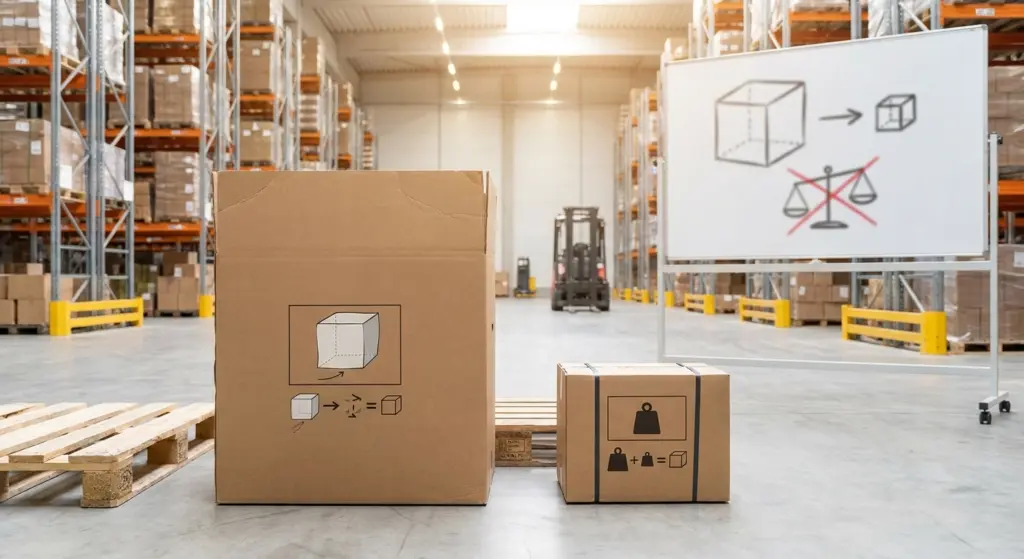
Volumetric weight, also known as density weight or dimensional weight, is the volume of a package converted into kilograms. It measures the space occupied in the transport vehicle, regardless of the actual physical mass of the contents.
Carriers introduced this concept to optimize the utilization of their transport vehicles. A light but bulky package takes up as much space as a dense, heavy package; it is therefore charged accordingly.
- Actual weight: the physical mass measured on a scale, in kilograms
- Volumetric weight: the package's dimensions converted to kilograms using a formula
- Billable weight: the higher of the two, used to calculate the invoice
- Two packages of the same size have the same volumetric weight, even if their contents differ
The principle is simple: the carrier always uses the higher of the actual weight and the volumetric weight as the chargeable weight. Ignoring this rule can result in significant surcharges, especially in international shipping.
How do you calculate specific gravity?
The Basic Formula
The universal formula applies to all modes of transportation:
(Length × Width × Height in cm) / Conversion factor = volumetric weight in kg
Dimensions must always be expressed in centimeters. The result is given in kilograms. The conversion factor, also known as the divisor, varies depending on the mode of transportation chosen.
Conversion factors by mode of transportation
| Mode of transportation | Divider | Ratio |
|---|---|---|
| Air Transport | 5 000 | 1 metric ton / 5 cubic meters |
| Road Transport | 6 000 | 1 metric ton / 6 cubic meters |
| Maritime Transport | 1,000 to 3,000 | Varies by shipowner |
The 5,000 divisor applies to air shipments, which result in the highest billable weights. That’s why optimizing packaging is particularly cost-effective for air shipments. Check out the MTI Express Air Freight Guide to learn more.
Practical Calculation Example
Let's take a cardboard box measuring 60 × 40 × 40 cm with an actual weight of 1 kg:
- Rough calculation: (60 × 40 × 40) / 5,000 = 96,000 / 5,000 = 19.2 kg billed
- Freight calculation: 96,000 / 6,000 = 16 kg billed
- The carrier uses the volumetric weight, which is much higher than the actual weight of 1 kg
Conversely, a package measuring 10 × 10 × 10 cm and weighing 5 kg has a volumetric weight of only 0.2 kg for air shipping: the actual weight of 5 kg is then used for billing purposes.
Which carriers use volumetric weight?
Policies vary by airline and destination. Here is a reference chart:
- Still in effect: FedEx, UPS, DHL, for France and international shipments
- International and overseas only: Colissimo (excluding the expanded European zone), Chronopost (excluding European exceptions)
- Express and International Shipping: TNT
- Never used: Mondial Relay
For Colissimo, volumetric weight does not apply to nearby European destinations such as Germany, Belgium, Spain, or Italy. However, as soon as the shipment leaves this area, the rule takes effect. Choosing the right carrier is therefore a key factor in your express shipping strategy.
How does volumetric weight affect your shipping costs?
Carriers use a rate schedule based on weight brackets, typically per kilogram or in 500-gram increments. If your shipment’s volumetric weight is slightly above a certain threshold, it may be moved up to the next weight bracket.
Reducing the dimensions of a package by just a few centimeters can therefore prevent it from moving up to the next size tier and generate immediate savings. Calculating this in advance before shipping protects your business’s logistics profitability and avoids surcharges during transit.
- Every centimeter saved in a dimension automatically reduces the billable weight
- Oversized packaging increases costs without providing better protection for the merchandise
- Regularly monitoring the actual weight-to-volume ratio helps you manage your shipping budget
8 Techniques to Reduce Bulk Weight and Optimize Your Costs
These eight operational levers make it possible to significantly reduce billed dimensions without compromising the protection of goods:
- Minimalist padding: Use only as much material as is necessary for protection
- Optimized standard sizes: Use boxes with standardized dimensions to minimize empty space
- Cardboard envelopes: ideal for flat items (textiles, documents, accessories)
- Extra-flat boxes: low-profile sizes to reduce the calculated volume
- Modular intermediate packaging: sizes that can be adjusted based on the exact contents of each order
- Shipment Consolidation: Combining multiple products reduces volume by up to 70% compared to shipping them individually (example: 100 pairs of shoes shipped as a single batch)
- Boxes with adjustable heights: precisely adjust the volume to fit the contents
- Staff Awareness: Train teams to pack packages more tightly and choose the right size
These techniques are particularly cost-effective for e-commerce businesses with high shipping volumes and margins that are sensitive to logistics costs.
FAQ – Frequently Asked Questions About Specific Gravity
What is the difference between volumetric weight and actual weight?
How can you avoid surcharges based on volumetric weight?
Is volumetric weight used in France?
Can I use an online calculator to estimate the volumetric weight?
Does volumetric weight vary depending on the destination?
MTI Express helps professionals choose the most cost-effective logistics solutions based on their needs: express shipping, courier services, air freight, or chartered freight. Our experts analyze your shipping flows to offer you the best pricing options.